If you like crime stories, you’ll love this. ‘True Crime: Hammersmith’ is the story of a deranged criminal organisation (Datadial) and the ensuing legal battle to stop it.
Chapter 1. The Best Intentions.
On August 17th, 2010; the world was rocked to its core when the Datadial blog posted an article titled ‘Increase Conversion rates – advanced techniques’. Of course, it all seemed fairly innocuous. A simple review of tools to help increase conversion rates on your website. The article named several companies and their websites and praised them for their techniques. Indeed, one man even thanked Datadial for the mention!
Clearly Mr. Eames didn’t realise that he was just a pawn in one man’s cruel game; the likes of which the legal world has never seen. …until now.
Chapter 2. The Worst Intentions 17th April 2013. Almost three years later. An email is sent from Fox Williams LLP to the author of the article and owner of the website, Mr. Robert Faulkner. The email was sent on behalf of Fox Williams LLP’s client, Shopzilla.co.uk. You’ve probably heard of Shopzilla. According to their Trade mark List of Goods and Services (which was supplied in the email) they specialise in: ‘Promoting sale of goods and services of others; Internet consumer comparison shopping services; providing ratings and reviews of businesses and products and services for use by consumers; providing databases containing commercial information relating to products and merchants’. As it transpires, Shopzilla had been mentioned in Datadial’s article all those years ago. Right at the bottom. As an honourable mention, as recognition for their online service.
Shopzilla had finally gotten wind of the article, after all that time; and they did the only thing any self-respecting company would do. They contacted their solicitors to have the link removed. Chapter 3. Motives Why did they want the link removed? Why indeed. Allow me to reprint the grounds of the legal action and analyse each point in-depth:
- Trade Mark infringement
- Causing detriment to the distinctive character of the Trade Mark;
- Causing detriment to the reputation of the Trade Mark by creating an undesirable association with the Infringing Website; and
- Taking unfair advantage of the goodwill attached to the Trade Mark.
Now… as I’ve mentioned, Shopzilla is legally defined as one that “provides ratings and reviews of businesses and products and services for use by consumers”. It sets itself up as one. That is the legal definition of Shopzilla. If acknowledging this definition is ‘detrimental to the distinctive character of the trademark’ and it creates an ‘undesirable association’ I daresay they might need to have a brand re-think. I wasn’t sure exactly what ‘Goodwill attached to the Trade Mark’ meant. Suing for a mention of your brand doesn’t seem like an act of goodwill to me. I have since looked up ‘Goodwill’ in legal terms and it pretty much means ‘the right to do business without direct competition’.
Basically not stealing other people’s business. (If anyone has a better definition, I’d welcome it in the comments). I’m not quite sure how praising a company prevents it making profits; but I’m fairly sure Datadial didn’t steal any of their market, or any other products that Shopzilla recommends on its site.
As requested, I’ll provide an account of the profits Datadial made through the use of Shopzilla’s name alone:
£0, 000, 000, 000, 000, 000, 000, 000
We’ll happily share in these profits with Shopzilla. It’s only fair.
2. Passing off [Fox William’s LLP’s] client’s goodwill Our client has invested significant time and money in developing the Shopzilla® brand making it instantly recognisable amongst the public as a trustworthy and reputable online comparison shopping engine. It is highly likely that the average consumer will be confused, believing that our client is in some manner connected with the Infringing Website, either through ownership and operation or through a commercial relationship or endorsement with the operator of the Infringing Website. Such connection is causing our client damage. As such, your use of Shopzilla® in this way constitutes passing off.
I had to open my legal dictionary again for this one. Basically ‘Passing off’ means creating an undue association between two parties, specifically one claiming undue association with the goods sold by another company. I’d like to state unequivocally that Datadial’s use of a link congratulating Shopzilla® on its use of product comparison is not an attempt to gain an association with Shopzilla® or any products sold or compared on Shopzilla®’s website. It would be interesting to see if Shopzilla® could provide proof that Datadial has stolen any of its business.
3. Copyright Infringement The use of the Infringing Website of text and graphics taken from our client’s websites is an infringement of our client’s copyright. You have copies and communicated the copyrighted work to the public through the Infringing Website. The use of the copyrighted work has occurred without the consent of our client, the copyright owner. We put you on notice that any continued use of our client’s text and/or graphics (in whole or in part) on the Infringing Website will constitute and infringement of our client’s copyright. This is without prejudice to our client’s position that you already have the requisite knowledge to establish such liability.
I was totally on-board until the last sentence. Even my module in Forensic Linguistics couldn’t have prepared me for that. I guess they’re suggesting that because Shopzilla® is a well-known website we should know that everything on their site belongs to them.
If Fox Williams LLP is reading this, I would recommend visiting The Plain English Campaign’s site. I’ve provided a link so you know what I’m talking about. . http://www.plainenglish.co.uk/ I hope they don’t sue me…
Legalese notwithstanding, Datadial hasn’t stolen any content from Shopzilla®. Neither text nor images have been used. Shopzilla®’s name wasn’t even used. It was a link via a URL, and you can’t copyright a URL. And even if you could (WHICH YOU CAN’T) it was a mention in a review so it’s fair use! What’s even more confusing is that Shopzilla appears to have sold out on Point 6 of its own philosophy:
‘Information is Empowering: Share it Wherever Possible’.
Chapter 4. Reasons. So far as I can tell there are no legal grounds for removing a hyperlink. We have been advised by Fox Williams to seek legal advice, so I am hoping the readers of this article can offer some help. Fox Williams have not mentioned that this is a link clean-up operation; and surely they would have gone down the normal route if that was the case. If they’d sent us a polite email asking for the link removal, we would have explained that since we have a reasonably high domain authority of 50+ the link in question would likely have little effect on their rankings and it’s 3 years old anyway so any effect would have been discounted anyway…etc As a precautionary measure we have taken down the link, as requested. If anyone has any thoughts on why Shopzilla wanted this link removed so badly, please share them here though keep it legal! Chapter 5. A riposte. Datadial is not a law-firm, but it is an internet marketing agency. We know how to use Google. Upon receiving the email, we took to the web to find out all we could about the legalities of Hyperlinking. Here are some insights into the subject as documented by Out-Law.com.
- “…hyperlinks do not transmit a work, (to which they link) they merely provide the viewer with information as to the location of a page that the user can choose to access or not. There is thus no communication of the work.” (source)
- “Just as an improved search-engine that improves the ability of users to locate material for which they are searching should not be required to obtain permission as a matter of copyright law, so providing links or access to material already publicly available should not be regarded as an act that requires any authorisation” (source)
- “every internet user enjoys access to the work simply by learning the uniform resource locator (URL) the court held. The hyperlink technique obviates the need to enter the URL manually and merely provides an easier and more convenient way to use the internet.” (source)
- “Kranten.com successfully argued that such deep linking to other sites is a widespread and commonly accepted practice on the internet and because, as in UK law, news articles can be copied for the purpose of reporting current events, provided there is sufficient acknowledgement.” (source)
The author of the original article has never been in trouble with the law. He’s an honest man who does business by the book. You can imagine his upset when he received the original letter. Faced with the fear that he would spend the rest of his life in prison, he considered transfering all of the company’s money to The Battersea Cat’s Home, and move to a Tibetan Monastery. However, he quickly rationalised the situation and sat down on his sofa with a glass of wine and a Twix. Since Shopzilla® and its lawyers are solely responsible for causing an undue amount of stress, it only seems fair that they reimburse him for the glass of wine and Twix. Twix: £0.80 Glass of wine: £2.40
– Update:
Chapter 5. Prologue.
Shopzilla’s VP has come forward to apologise for the misunderstanding. The apology is in the comments below. They acknowledged that it was a mistake and said they were sorry it happened. I guess we’re not being sued anymore!
–Update 2:
We just received a courier delivery…

I wonder what it is…

Well, how about that! A bottle of Red Wine and a box of Twixes. Thanks very much Shopzilla!


What is Movember?
- Movember (a combination of the terms Moustache and November), is an annual national incentive welcomed far and wide by mo bro‘s (Movember brothers, I think) who help to raise awareness for men’s health, specifically prostate cancer and other male cancer initiatives, by the growing of their moustaches.
- The idea was launched circa 1999 by a group of 80 guys in a pub in Adelaide – and since then has gotten great publicity for it’s cause, with ambassadors including many well known celebrities such as Justin Bieber, Snoop Dogg and UFC Lightweight Champ Frankie Edgar.
- The campaign has even gone on to partner with Google Chrome to create a video:
Great! – What can businesses learn from Movember?
Aside from the success that comes with the genuine promotion of a charitable cause, there are many things all business owners and it’s employee’s can learn here, including:
1) Teamwork increases the odds of success!
It was a team of 80 guys that first started the initiative, not just one. Now, while it is entirely possible to begin something on your own and grow it from there, it is so much easier having people agree on the same thing from the start.
Aside from the team of people being on the same wavelength, being part of something gives it more power, which gets things going faster than if you have to wear all the hats yourself!
2) The best gains can be gotten through giving something away!
There’s a reason why on your lunch-break, if you’re lucky you’ll see a coca-cola van parked up, attached to a trolley full of free drinks it’s giving away – branding.
Being known to seduce potential customers with your product is an age-old tactic and is regularly used, use it!
The original mo bro’s gave away their freshly shaven upper lips and gained tonnes of cool-points in return.
Whatever your business niche, offer up some freebies! It might lose you money in the short run, but could very well gain you leads and will strengthen your brand awareness in the long run.
3) People outside of your niche, will help you – if what you are doing helps them!
With the recent banking scandals and shortfalls related to the Olympics, it might be hard to believe it, but people like to be nice! – Even more so when other people appreciate their niceness.
One example of this is Qantas - the flag carrier of Australia, who painted a moustache on one of its airplanes in aid of the charity in 2011.The famous ‘tache can also be spotted at the Qantas terminal where it is displayed proudly on the entrance building:

The business of aviation isn’t particularly well known for charity among the masses, however Qantas getting involved in this shows that it doesn’t matter what you do, it will be recognized if there is genuine goodwill behind it!
4) Forget paid promotion in hopes of going viral, if your idea/cause is a good one, that is PR enough!
It’s true you can buy your way to a million views on YouTube and etc. but I’m guessing the satisfaction isn’t nearly as close to when something genuinely takes off!
Of course working with internet giants Google can bring any cause to the attention of the masses, mostly because Google pretty much run the inter-web. However, it wasn’t Google that shed light on Movember alone.
The charity worked its own way to the forefront for many reasons the biggest being that it relates to men, who make up a huge scale of the population!
Allowing/encouraging others to get involved in your cause, means they’ll feel closely related to it, and if it appeals to them personally they’ll be even more likely to continue or at least acknowledge it among peers.
After that, going “viral” is almost the next step, simply because people will want to be a part of something so good!
Ask Men‘s Movember movie comedy short:
MovemberTV: Movember’s Impact on Awareness
Topic in question:
Google Adwords’ image search ads
Are these new?
Well yes and no. No technically, since they were originally launched at a Google Search event back in 2010, but to you – yes if you have never used them before, obviously.
What are they?
In short, they are ads that include images similar to the ones you see on the search network as part of a PPC campaign.
Where do you use them?
These can be used as part of your online advertising campaign in Google’s display network. Specifically, they will appear at the top of Google’s image search above the lines of images returned. Here is an example:

Why would you use them?
For many reasons. There is a huge untapped opportunity to be found via the images you have on your website than just through regular SEO. For instance, through the ALT-tags used in your images. These can lead people to the content on your website.
Also, often people are genuinely just looking for an image rather than actual text content – for instance when looking for new shoes, or any product they are interested in. This is a great chance to draw in prospective customers.
Hold on, don’t we already have image ads on the display network?
We sure do!
So, how are these different?
They’re completely different. Image ads are ads featured in Google’s display network. This network is different from Google’s search network. Instead, it is a large collection of websites that are in a partnership with Google that work to display graphical ads that have been built with the display ad builder.
Those ads look like this:
Will these cost me more than usual search ads?
No, you can bid on relevant keywords as you usually would. So this will only cost you as much as you choose to bid.
Any tips for effectiveness?
Google advises you create a separate campaign for these kinds of ads. This way you can gauge quality scores much more accurately and hone the campaign in a way that works best.
Things to keep in mind?
Although a useful way to advertise, it is worth noting that there are no guarantees this will be a huge success in terms of conversions, and as with text ads, it is a process of constant tweaking until you find what works.
Some users have suggested that this is something that best works with tangible products (on e-commerce sites) where someone will search to get an idea of a product they will eventually wear, use or feel (i.e furniture, clothing or decoration).
If your product doesn’t fall into this band, then the outlook for image ads search might be branding; a way to advertising the visual aspects of your services. Low Cost Holidays does a good job of this. Here, I searched the term winter holidays:

Okay where do I start?
You can explore this feature in Adwords by selecting a campaign on the left and then selecting ads from the top panel. From there, select new ad and then Specialised – Search from the drop down menu:

Follow the instructions from there. – Good luck!
Online trading is a fast paced world. Whether it be in stock and shares, grants for start-ups or otherwise, there aren’t many examples to date that show the benefits of waiting around.
Let’s look at some examples of once leading technologies, that have recently or notably had to resort to publicising selling shares, or changing hands to stay (or become) relevant; which of these companies/ventures/subsidiaries do you still associate with “cool“?:
MySpace
Known originally for: Pioneering the discovery of new music online…
Now thought of as: A dated money leaking endeavour that has passed hands more than a hot potato.
AOL
Known originally for: The only key to dial up internet…
Now thought of as: American acronym that we see online from time to time, mostly trying to be spammed-in as the default homepage for your browser when downloading freeware.
Yahoo!
Known originally for: Groundbreaking search engine and most famous Google competitor…
Now thought of as: Fairly annoyingly designed interface that we’re surprised is still around.
Digg
Known originally for: Quirky news discovery site…
Now thought of as: Recently sold to a company for $500, 000 (much less that it was once worth ($175, 000, 000)
Known originally for: The new zeitgeist and awesome brainchild of cool-techie Mark Zuckerburg…
Now thought of as: Slightly spammy/stalky connect-service offering the chance to re-establish relasionships with distant relatives & old “friends”
Known originally for: Newbie picture service that made Twitter pics look really cool…
Now thought of as: Lovely money-maker for start-up entrapeneur Kevin Systrom (he knew when to sell)
Hotmail
Known originally for: Having a great customizable email service that tied closely to MSN messeger and then windows live…
Now thought of as: Uber-spammy email service that looks outdated & unsure of its design.
RIM/Blackberry
Known originally for: Creating the Blackberry; a respectable device for business-people…
Now thought of as: Annoying pingy device taken over by tweens and teeny-boppers who got excited about its messaging service, which is essentially not far from a text message.
Bing
Known originally for: Competing with the big boys and girls (basically Google) and doing that respectably…
Now thought of as: A failed Microsoft endeavour, that was close – but no cigar…
Last.FM
Known originally for: Clever algorithms that tailored music choices to the listener based on entering a few personalised details…
Now thought of as: Recently hacked music service that was long out-thought by competitors (Pandora, Spotify and iTunes’ “Ping“)
Kodak
Known originally for: Pioneering photo technology as we knew it and introducing a sense of class to both the disposable and polaroid camera…
Now thought of as: A once amazing company that failed to follow technology into the world of digital and subsequently faced insolvency.
Don’t get left behind…
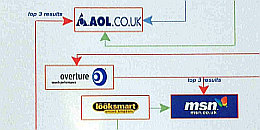
I recently found this leaflet in the bottom of my draw. It shows how all the different search engines used to relate to one another and how they got their results.
It bought back memories of how it used to be in the search engine game. It also shows how long we’ve been in the SEO game compared with some of the other jonny come latelys!

There has been a lot of discussion around the search marketing industry over the past few weeks thanks to what many consider to be a pretty major update released by Google. There has been a lot of speculation that has followed with some good and not-so-good advice as a result.
With all of this information floating about it’s difficult for anyone without their ‘ear to the ground’ to get a concrete understanding of exactly what ‘Penguin’ is, and what the effects have been. I’ll put the speculation to one side for the moment and start with the facts:
What is it?
Google’s latest update aimed at rewarding high-quality sites in search results by targeting and demoting sites appearing ‘overly optimised’. Some sites that have used or are continuing to use outdated tactics (specifically tactics to get other websites to link to theirs for the purposes of improving rankings in search results) have been affected by this, however there are reports of websites that have never engaged in such tactics being affected by the update as well.
When did this happen?
Google released a blog post stating that the update would roll out “in the next few days” back on 24th April- almost one month ago at time of writing. Most sites affected by this will have noticed changes around 24th onwards.
How to I tell if I was affected?
Sites affected by the update will probably notice a change in rankings and visits from organic search traffic (specifically visits from Google) around this time. If using Google Analytics you should be able to tell by navigating to ‘Traffic Sources’->’Sources’->’Search’->’Organic’, making sure you have a date range that spans a few weeks before and after this date. To be sure it’s best to limit the data you are viewing to Google only. Look for ‘Primary Dimenson’ and click ‘Source’ next to it to give you a list of organic search sources, and click on ‘google’:
The example above shows a drop in visits from organic search (specifically from Google)- if you see a consistent increase in visits around this time it is likely that a competitor may have been affected and your site may have improved in rankings as a result.
OK it looks like my site has been affected- What else do I need to know?
1- You’re not alone-
thousands of sites have been affected by this update- some undeservingly so (to the point where Google has created a feedback form for sites that don’t believe should have been affected by the update)
2- Penguin is an algorithmic update- it isn’t personal.
Google has identified your site as being within this ‘category’ based on the data it has, not due to a human reviewing your site personally.
3- Reconsideration requests won’t help-
SearchEngineLand.com reported:
“Because this is an algorithmic change, Google has no plans to make manual exceptions. Webmasters cannot ask for reconsideration of their site, but we’re happy to hear feedback about the change on our webmaster forum.”
4- Noone that has been affected by Penguin has recovered… yet-
There is a wealth of speculation and tips for recovering from the penguin update online, however noone can confirm what the best solution to recovering from this update is. Currently there has been no ‘refresh’ or ‘reevaluation’- sites that were affected are still in the same boat.
5- Penguin isn’t ‘real-time’-
Like the ‘Panda’ updates before, the Penguin update isn’t continually reevaluated in real-time, meaning any changes that are made now won’t have any impact until Google reevaluates their data at a later date.
How can I get my traffic and rankings back?
The only certain answer at this stage is no-one can be 100% sure (as with pretty much anything within the SEO sphere), but the potential signs of redemption lie in evaluating the existing links to your website and the methods used to attract links from external websites.
Microsite Masters released some interesting findings of sites they analysed that had been affected by the Penguin update:
“every single site we looked at which got negatively hit by the Penguin Update had a “money keyword” as its anchor text for over 60% of its incoming links. On the other hand, the sites that were not hit by the update had much more random percentages.”
This suggests that sites with a higher percentage of links that use the keyword they are trying to rank for (‘money terms’) in the clickable part of the link to their website (‘anchor text’) are more likely to have been affected by this update. This isn’t a ‘one size fits all’ issue, and I’m certain that Google would have considered several other factors rather than the percentage of keyword-rich links a site has, but suggests that Google are looking for more evidence of brand promotion rather than search engine manipulation when assessing the links to your website.
As with other large updates introduced by Google in the past, this re-emphasises the importance of diversifying the sources of income your business as a whole has. Depending on one revenue channel alone can be risky- even when times are good, so it’s important to remember that channels such as paid search, email marketing, online PR, affiliate marketing and social can be profitable.
img credit: opencage.info
I am yet to find many examples of ways in which companies have implemented their Cookie alerts on their website.
This is probably not surprising as it’s yet to come in but the day is drawing near.
Here are some examples. I will add more as I find them. Please feel free to suggest your own.
Virgin.com – Wow you’ve got to be keen to bother reading all that. And still the buttons are confusing.
What about “Yes please, use cookies.” “No thanks I don’t want cookies”

BT.com
Quite sneaky here. BT have popped the box at the bottom right hand side of the page. Be quick though as it disappears after 20 seconds. Also you need to have a lot of time on your hands to decide which cookies to accept and which not to.

Zebedee Creations
These guys have had their policy in place for over a year which is quite surprising. It reminds me of the moment in Blackadder II where on a voyage of discovery with Captain Rum the water runs out aboard ship and they have to turn to drinking their own urine only to find out that Baldrick has been drinking his own for a year already – he prefers the taste!
Nice simple solution though.

www.eu-cookie-law.com
Simple solution, which disappears after about 10 seconds. Presumably they think that not actively agreeing is presumed acceptance? Is this legal?

So, what’s the problem?
Nothing, if you haven’t been massively over-zealous about how well optimised your website is. Being vigilant and up to date isn’t a problem, the issue Google is trying to fix relates to those link-fiends who have over-used their ‘white hat’ so much so, that is has turned a miserable shade of grey (In case you’re confused, I refer to this post).
Okay, so what is ‘over-opimisation’?
In a nutshell, it’s the act of doing everything that is possible to optimise your website, in a non-human and bot-like way.
Examples?
Sure, over optimisation can include (and will probably be identified by inclusion of ) any of the following:
- Scraped, copied web content
- Too many ads on the page & not enough original content and copy
- That fact that your website loads faster than the speed of light
- When all links that are inbound and have identical anchor text
- Infinite forum links
- Hidden text (in a colour that matches the background, so it can’t be seen)
- Sites linking to you that are dodgy or malicious in any way
This list is not exhaustive as there are many more examples of things Google might suspect & then penalize you for.
Below, I’ve included a helpful video from SEOMoz’s very own Rand Fishkin that does well to explain what changes should be made to save your site from dropping in the ranks and possibly fading into obscurity online after Google’s next update:
Parting words?
Good luck!
1. Less is more
I could write you a list (but I wont) of the number of photo sharing applications, tools, add-ons and features the internet has to offer, that didn’t just sell for $1 billion dollars to Mark Zuckerberg. So what made Instagram so desirable?
To answer that question, we must look at what it actually does:
- Instagram is a free photo sharing program that allows users to take a photo, apply a digital filter to it, and then share it online.
That’s it? Yep, that’s it! Whilst many developers often try to create something so innovative, exciting and unheard of, that it is often unnecessary. It’s popularity proves that all people really want to do is upload cool looking pictures to the internet and have people “ooh” and “aah” at them.
2. The company you keep speaks volumes about you
It’s true. It’s been true since you were old enough to know what street-cred meant and cheeky enough to be selective about what shoes your parents bought you for school because the popular kids were wearing them.
Once Instagram attached itself to the iPhone, it was the inception of something brilliant. In business, you are not trying to reach everyone on the planet because that is impossible. Greatness is often born out of a niche. That is exactly why Tesco and Waitrose can exist in harmony – each business appeals to the pockets of a particular consumer and does that really well. That’s all you really need; to please your niche consistently.
3. Make changes before completely giving up
Kevin Systrom created Instagram only 2 years ago in 2010. However before you call him an upstart that got lucky, consider his earlier attempts with Photobox in 2004 that allowed you to send large images to a friend online, followed by Burbn, a useful HTML project allowing you to update people on your location and then Instagram. Each idea was a good one, but Instagram, was and is a great one! Kudos Kevin!

Datadial sign with Lengow, providers of Multi Channel Software

I am pleased to announce that Datadial have agreed to provide an automatic feed to Lengow’s powerful multi-channel marketing platform as standard functionality within Datadial’s e-commerce software. This will now be made available for all new Datadial clients.
Who are Lengow? Lengow provide a comprehensive multi-channel marketing solution for those clients wanting to trade their products on Ebay, Facebook, Google Shopping, Amazon or many of the other 3rd party shopping channels.
Lengow allows you to manage all your products feeds from one source as well as track ROI. You no longer need to log on to each distributor’s interface to find out the performance of your various feeds. The Lengow solution takes care of centralising them for you.
Number of clicks, sales or ROI… the Lengow feed management solution gives you a 360° view of your data in real time.
This is just another piece of the jigsaw in making our e-commerce software the most search engine friendly and most marketing friendly software out there.
For more information contact me, Robert Faulkner
Barry from Search Engine Roundtable posted an interesting find from a Google Webmaster Central forums post. The OP pointed out that PC World (a leading electronics chain in the UK) is ranking with “Mothercare” (a leading baby/parenting chain in the UK) as it’s title in search results for the term ‘PC World teeside park’:
I’m still very intrigued as to how this happened, but after some digging around I think I’ve found a reason why (which I posted on Barry’s post).
1- It’s showing up for ‘mothercare teeside park’ as well (suggesting it’s not ‘one way’). Both results show a Google Places result with the same address and a phone number: 01642 618325
2- A quick search for ’01642 618325 pc world’ returns http://uk.wowcity.com/hartlepool/?what=digital+camera+consumer+products
3- On this page the first result for Mothercare links through to PC World’s homepage (although the details are correct for Mothercare). Note this passes through an internal tracking script and isn’t a direct link.
This looks to me like an error in Wowcity’s listing as the cause of the problem, and probably isn’t anything to do with the folks at PC World or Mothercare (or the agencies they may be working with), but is an interesting fine nonetheless.
If my theory is correct it begs the question- Does Google Places trust it’s citation sources too much? Would love to hear your comments (particularly if you work for PC World, Mothercare and Wowcity!) below.