There are a million and a half blog posts about how Online Retailers keep their drop-off levels down; but what methods do they have in place to make you loosen up with your spending.
Charities have been doing it for years. Getting you to put your hand in your wallet is their speciality. Just when you thought you would ignore their pleadings something tugs at your heart strings. A little niggle that says “do it now, you know you want to”. Anyone who’s watched Jeremy Kyle knows what I’m talking about. Right after the Foxy Bingo guy announces the break, you’re confronted with 4 minutes of hunger-ravaged children reaching out from the Plasma Screen. It’s emotional Blackmail.
But it’s effective…
Online retailers are getting in on the action too. They haven’t quite gone down the guilt road yet (though I’m sure they would if they could) but they are playing with your mind to get you to ACT NOW and not go elsewhere.
…Pulling on the purse strings if not pulling on the heart strings.
It’s even more difficult to create that sense of urgency online, especially when it’s so easy to check prices and offers on other retail websites. Even a website has the right product at the price you’re willing to pay; you would more than likely check elsewhere. So the only weapon left in the web retailers’ arsenal is the notion that if you don’t buy something there and then, you’ll lose it forever.
So let’s see what online retailers do to keep us from doing a wider search, making a coffee, talking to the wife, walking the dog, looking up trivia from The Godfather, looking up how tall Andre the Giant was, looking up the longest recorded flight of a chicken, sitting on Reddit for 2 hours and then going to bed having forgotten we wanted to buy anything in the first place!
1) Act Now to Avoid Dismemberment. I mean Disappointment

You’ve probably seen this on concert ticket sites especially. “only 2 tickets available at this price – book now to avoid disappointment.” Is this really true? Can it really be the case that every time I search for an airline ticket, only 2 seats are available on the flight that I wanted to take? It’s the travel-ticket equivalent of a Saw trap.
‘All your life you’ve enjoyed a leisure of choice when buying things online, but now you have 30 seconds to decide, or lose… everything!’
It’s incredibly persuasive and a panacea for retailers who are faced with an audience of fence-sitters and flip-floppers.
2) Safety in numbers
‘17 others are looking at this item now’.
’29 people are watching this item’
‘143,343,123 people are scrambling for their card details so they can buy this item and you can’t!’
Talk about putting the frighteners up! Nothing invokes a reaction like a bit of competition. Regardless of whether it’s true or not, these stats make you feel two things:
a) This product is in high demand and might run out.
b) This product is popular, so it must be good.

Suddenly certain things like price comparisons seem less urgent. I was going to go and see if I could get it cheaper elsewhere but I can’t risk losing out to other shoppers. I might never see a Self-Stirring Mug at this price again!
The painful things about these methods is that you actually have no idea if it’s true of not. It could just be automated. But does the risk outweigh the reward? Probably not.
3) What’s in a Name?
‘Wayne in Manchester also bought this item’.

Although this isn’t one of the sweat-inducing panic-purchase inducers we’ve come across so far, it could be the push needed to get you to click ‘buy’. Chances are, ‘Wayne in Manchester’ isn’t your friend or financial advisor, so why does his opinion matter? It’s possible he’s not even real! But the fact that someone bought the item is enough of an endorsement to tip even the most frugal shopper over the edge.
If you don’t believe me; think of all those times you’ve been looking at an item on Amazon and thought ‘Nobody’s interested. There must be some hidden catch I’m not seeing.’ Or you’ve been browsing Ebay and seen an item with no bids: rather than thinking ‘wow. I must have stumbled on a bargain’, you think ‘I must be missing something here!’.
Maybe this says something about mob mentality, maybe we just like to follow the herd. It works well all the same, and ‘Wayne in Manchester’ is presented as the spokesman of wise purchasers and his presence on the page alone is enough to egg you on to buy something.
4) Is that a ‘Buy’ Button on Your Page, or Are You Happy to See Me?

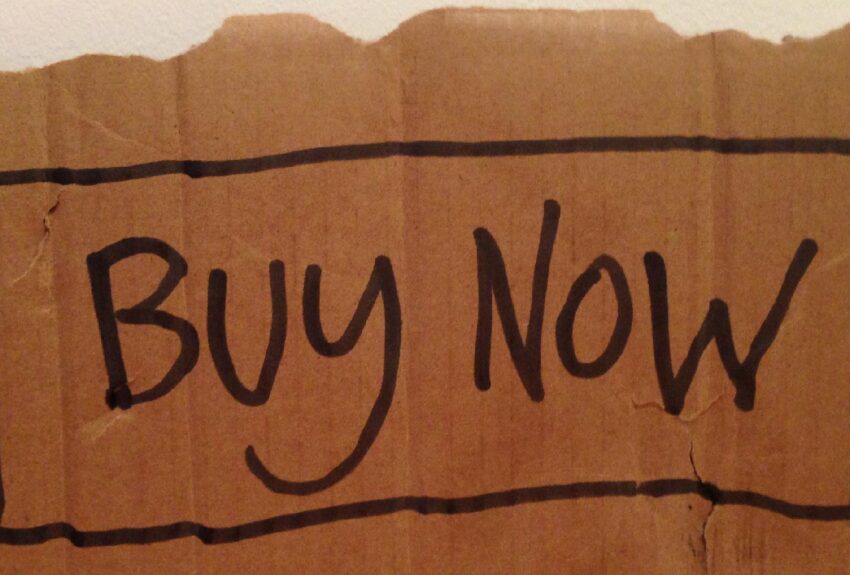
Basic as the big [BUY NOW] button seems, it’s the dominant feature of the page.
For those of us who have gotten to grips with Traffic Signals, Green means GO! GO, GO, GO! So it’s no mistake that the only colour on the page is green, and subsequently the whole page screams ‘BUY BUY BUY’. Psychologically, we’re hopefully still capable of exercising some decorum; we are free-thinking people after all. But with structured, thought-out tricks like this, turning away has never been harder.
Even as I write this I want to click on the screenshot image, just to do as I’m told. It really sucks you in like a blackhole (or maybe a greenhole?). You have no chance.
5) And That’s Not All!

As well as all the mind games and emotional turmoil these companies make us go through to convince us to buy things; occasionally they’ll throw you a treat to sweeten the deal. Like when I recently bought 77 Antique Globes. The Price-Tag of £60,830.00 seemed a little steep and I must confess I was in two minds about whether to click ‘Buy’. But when I realised that the company offered Free Delivery, I couldn’t help but go ahead with the purchase.
Now I’ll never be lost again. But I will spend the rest of my life cursing myself for falling for the ‘free delivery’ option. Other sales incentives (also known as ‘close incentives’ or ‘things that are so cheap we can give them away for free without affecting our profits’) include ‘10% off your next order when you buy now’ and ‘Free warranty up to 30 days!’.
So now we’ve identified the ways in which online retailers fishhook us into a sale, we can go back to shopping online with a renewed sense of freedom. There’s no way any of us will ever fall for those tricks again.

‘Google Authorship’. You’ve probably heard it being bandied around and if you haven’t taken the time to look into it, now’s your chance. Google Authorship will arguably prove to be the most significant tool for building rankings that Google has ever introduced; and if you’re smart about it, you can start benefiting immediately. This post will explain what it is, its implications and how to use it, so it’s a great place to start. Before we begin, it’s important to say that Authorship and AuthorRank are separate, but inescapably linked. Just like nobody ever talked about Tom without mentioning Jerry, it’s hard to talk about Authorship without thinking about AuthorRank.
What is Google Authorship?
Nutshell time!
Google Authorship is Google’s strategy of linking web authors to their online content. So anything you write online can be linked to your online profile (no prizes for guessing it’s your Google+ profile). Google haven’t officially said that this will lead to a writing-quality based ranking system; but they’ve implied it pretty heavily. In 2007, Google patented something called ‘Agent Rank’. You can take a look at the patent here , but if you’re not versed in patent law, Bill Slawski gives a pretty good run down over in February 2007.
Obviously we’re now spoiled by blogs explaining where they were going with this patent, but with the advent of Google+ and Authorship the theories are starting to become an impending reality.
Be Careful
It’s important to remember that Google Authorship and AuthorRank are separate entities.
You can read all about Authorship at the horse’s mouth; but broadly, it’s the link between authors and their content. AuthorRank is the rating system associated with this link. Authorship is in operation now. AuthorRank isn’t.
In a lot of press stuff the G-team has been saying the main focus of Authorship is to link authors to their content. Google Software Engineer, Othar Hansson appears to be obsessed with the fact that it puts your picture next to your post on SERPs and the psychological benefits of this in terms of connectivity. In his words, it’s Google’s way of ‘making the internet more human’. It’s a lovely sentiment, but cynical-old-me still thinks this is all part of the much bigger AuthorRank picture. And that’s not a bad thing. AuthorRank will be a great way of promoting online content based on the merit of its production and weeding out spammers. It punishes anonymity, but celebrates connectivity, and that’s surely a step in the right direction.
AuthorRank isn’t officially in use yet, but the buzz around it has become almost deafening and smart money is on it being run as an operational algorithm very soon.
But, back to Authorship…
Why should Authorship bother me?
Why shouldn’t it? This is the first chance we’ve been given to associate all of our online work in one centralised beacon. If, like me, you originally avoided the Google+ hype, change your mind now, or you might just get left behind.
There’s never been a better reason to join up. It will ensure you get the praise you deserve for the stuff you’ve written in your field of expertise by linking to similar articles you’ve written. In fact, that plan is already in action. Matt McGee has found that as soon as you’re finished reading an article by an author signed up to Authorship, you press ‘back’ on your browser and Hey, Presto! You’re presented with more articles on the same subject from the same author. This is the perfect type of promotion and will benefit your traffic in no time.
Pros and Cons of Authorship (and, inevitably, AuthorRank)
Let’s take a look at the effects Authorship could have on your business:
Pros
- Association with good writers and good content is bound to have a positive influence on your site’s PageRank. AuthorRank will undoubtedly go hand-in-hand with PageRank!
- People will be able to interactively see the merits of your site by clicking the author links on each post.
- Verified quality writers will encourage more people to link to your site. It’ll work wonders for Domain Authority.
- What if that writer who’s earned you all those Click-Throughs leaves? Well, they’ll always be tied to the domain that published their content. So even if they stop writing for you, as long as you both stay on top of your game, you’ll both benefit.
- You’ll get more Clicks because people will trust that smiling Rich Snippet of yours more than they trust a farmed-in link.
- People will be more willing to contact you with their thoughts. That means you’ll be able to engage more with your audience.
- Spammers will be much more easily identified. No Authorship will mean no verified author. Quality content will be rewarded.
Cons
- If you rely on one writer for a high ranking/readership and they leave, you’ll have to work extra hard to keep on top and stay fresh. But there’s nothing new there!
- Authorship can’t be attributed to your company, only to your writers.
- Authorship can’t be attributed to a team, only to ONE writer.
- It acknowledges the achievements of individual writers rather than a whole business.
(But the kudos is shared by association, so everyone’s a winner.)
One point which is a mix of a Pro and a Con: a lot of people have been reporting that their Rich Snippets have taken weeks or even months to show up. Generally, Google seems to giving it on a priority basis to people they think have earned it. That is, people who are getting a lot of traffic for a lot of posts. It seems a little harsh to begin with, but at least this way you know Authorship has truly been earned.
At face value, the pros seem to outweigh the cons; and the cons concerning companies benefiting from the writing of their employees seem to be part of an on-going morality battle. Is it OK for an employer to take credit for their employees work? That’s a question for another time on another blog. But in any case it would seem that Authorship unequivocally promotes and celebrates individualism and, to bang the Marxist drum, denies the power of anonymous corporatism.
How Can I Get On Board?
2 Things you’ll need for Authorship before you start out:
- Online Content (you already have that though, right?)
- A Google+ Profile!
I don’t have Google+!
Let’s start from the start. I’ll show you how to set up a Google+ profile from Scratch; using the perfect blank slate: me!
Step 1: We’ll pretend like none of us has a Google account and start from the front door. Head over to Google+
Step 2: Fill in the Details form

Step 3: After a verification process, you’ll be presented with this box:

Step 4: Get your photo up! This will be the photo used in your Author Rich Snippet.

Step 5:
… and Get Involved!
There are plenty of posts around the web that can give you a complete overview of what Google+ has to offer, but since this post is about Google Authorship I’ll leave you with one piece of advice:
Use Google+ as much as possible. The more you engage with your profile and the circles you build, the more you’ll gain from the service and the more strength you’ll have around the web.
So how do I link between my profile and my posts?
Well, there’s a lot of ways this can be done. The process can be quite confusing, but Rick DeJarnette gives a decent overview.
NB. It’s still a little jargony in places.
I’ll break it down as best I can in a second, but if the HTML stuff gets too much, feel free to watch this video of Matt Cutts and Bond-Villain-in-Waiting, Othar Hansson looking uncomfortable and explaining the HTML coding in very accessible terms.
For Sites with One Author:
If you have an email address on the same domain as your published work:
Step 1: Head over to the Authorship sign-up page and fill in the form.
Step 2: Click ‘Verify’ in the Verification Email.
Step 3: In the ‘Edit Profile’ section of your Google+ profile, you’ll now find you’re a ‘Contributor to’ the domain of the email.
![]()
Step 4: Start writing as much as possible at that domain. The more Google sees people are looking at your content, the more important Google thinks you are and the sooner you get your picture on the Search Page.
If you don’t have an email address on the same domain as your published work:
This may also be useful for posts in blogs where you’re a guest poster.
The best way in this case is to include a hyperlink with an HTML “rel=author” tag at the bottom of each page you write.
Basically, rel=”Author” is a way of telling Google that the author of this page is at the other end of this link.
The complete HTML link will look something like this:
<a href=”https://plus.google.com/101369752982717498462#101369752982717498462?rel=author”>Joe Shervell</a>
And behave something like this:
Now go back to ‘Edit Profile’ on your Google+ page and edit the ‘Contributor to’ section to include the site you posted to. It may be more beneficial to give the exact URL of the page, like this:
![]()
But reportedly listing the domain’s homepage will still work fine.
My site has multiple authors.
That’s ok, so does ours!
Step 1: Make sure you have a Bio Page set up for each writer. Something like this.
Step 2: Set up a Hyperlink from the Content Page to the Bio Page, but make sure you include our old friend, the rel=”author” tag.
Step 3: Set up a Hyperlink from the Bio Page to your Google+ profile, but this time include a rel=”me” tag. Simply put, Google will read this as you saying ‘this is me’.
Step 4: Head back to “Edit Profile” on your Google+ profile and enter the URL of the bio page in the “Contributor to” section.
That’s about the size of it!
But I use WordPress. What about me?
If you’re WordPress savvy then it’s really straight forward:
Step 1: Grab yourself a copy of a plugin like this one.
Step 2: Install it (It’s all explained in better detail right here)
Step 3: Fill in the information on your WordPress User Area.
Step 4: Keep posting and sharing and Google will notice you and give you your well-earned Rich Snippet.
So I’ve Set Up Authorship. Now What?
By setting up Authorship you’ve put yourself on Google’s radar as a writer, and that’s a huge step in the right direction. When AuthorRank does arrive, (and it’s not a matter of if, but when?) the more prestige you’ve earned as a writer, the better.
Use your Google+ profile to interact with your community of readers. Write about what you know, and write about it well. Google will see you as someone worthwhile in the field and give you a better rating in the rankings battle. This ‘writing about what you know’ is an important point. If you’re Noam Chomsky, then Google will recognise all the stuff you’ve written on Language Acquisition and if you decide to blog about it, you’ll be rewarded with high rankings based on your previous work. If you’re Noam Chomsky and you decide to write a blog post about Animal Husbandry in the Serengeti; you might not get the same level of respect.
That seems like an important point; one that I’m loathe to gloss over. Google Authorship can reward expertise. If you build a following and recognition as a writer in a certain field, then it will be reasonably safe for Google to assume that anything you write on that subject will be of a similar calibre. That’s not to discourage you from branching out into other fields; but if you do, make sure you have a community willing to accept that change or you might be punished by negative response.
To sum up neatly; Authorship is essential to let Google know you are a legitimate and quality writer who isn’t out to scam or spam. In the future, AuthorRank will come into the equation, and when it does, make sure you’re ready by building a big following and professional group now on Google+.
And even if we’re all wrong about AuthorRank… what’s the harm in having Google’s Seal-of-Approval on your work?
Topic in question:
Google Adwords’ image search ads
Are these new?
Well yes and no. No technically, since they were originally launched at a Google Search event back in 2010, but to you – yes if you have never used them before, obviously.
What are they?
In short, they are ads that include images similar to the ones you see on the search network as part of a PPC campaign.
Where do you use them?
These can be used as part of your online advertising campaign in Google’s display network. Specifically, they will appear at the top of Google’s image search above the lines of images returned. Here is an example:

Why would you use them?
For many reasons. There is a huge untapped opportunity to be found via the images you have on your website than just through regular SEO. For instance, through the ALT-tags used in your images. These can lead people to the content on your website.
Also, often people are genuinely just looking for an image rather than actual text content – for instance when looking for new shoes, or any product they are interested in. This is a great chance to draw in prospective customers.
Hold on, don’t we already have image ads on the display network?
We sure do!
So, how are these different?
They’re completely different. Image ads are ads featured in Google’s display network. This network is different from Google’s search network. Instead, it is a large collection of websites that are in a partnership with Google that work to display graphical ads that have been built with the display ad builder.
Those ads look like this:
Will these cost me more than usual search ads?
No, you can bid on relevant keywords as you usually would. So this will only cost you as much as you choose to bid.
Any tips for effectiveness?
Google advises you create a separate campaign for these kinds of ads. This way you can gauge quality scores much more accurately and hone the campaign in a way that works best.
Things to keep in mind?
Although a useful way to advertise, it is worth noting that there are no guarantees this will be a huge success in terms of conversions, and as with text ads, it is a process of constant tweaking until you find what works.
Some users have suggested that this is something that best works with tangible products (on e-commerce sites) where someone will search to get an idea of a product they will eventually wear, use or feel (i.e furniture, clothing or decoration).
If your product doesn’t fall into this band, then the outlook for image ads search might be branding; a way to advertising the visual aspects of your services. Low Cost Holidays does a good job of this. Here, I searched the term winter holidays:

Okay where do I start?
You can explore this feature in Adwords by selecting a campaign on the left and then selecting ads from the top panel. From there, select new ad and then Specialised – Search from the drop down menu:

Follow the instructions from there. – Good luck!
Online trading is a fast paced world. Whether it be in stock and shares, grants for start-ups or otherwise, there aren’t many examples to date that show the benefits of waiting around.
Let’s look at some examples of once leading technologies, that have recently or notably had to resort to publicising selling shares, or changing hands to stay (or become) relevant; which of these companies/ventures/subsidiaries do you still associate with “cool“?:
MySpace
Known originally for: Pioneering the discovery of new music online…
Now thought of as: A dated money leaking endeavour that has passed hands more than a hot potato.
AOL
Known originally for: The only key to dial up internet…
Now thought of as: American acronym that we see online from time to time, mostly trying to be spammed-in as the default homepage for your browser when downloading freeware.
Yahoo!
Known originally for: Groundbreaking search engine and most famous Google competitor…
Now thought of as: Fairly annoyingly designed interface that we’re surprised is still around.
Digg
Known originally for: Quirky news discovery site…
Now thought of as: Recently sold to a company for $500, 000 (much less that it was once worth ($175, 000, 000)
Known originally for: The new zeitgeist and awesome brainchild of cool-techie Mark Zuckerburg…
Now thought of as: Slightly spammy/stalky connect-service offering the chance to re-establish relasionships with distant relatives & old “friends”
Known originally for: Newbie picture service that made Twitter pics look really cool…
Now thought of as: Lovely money-maker for start-up entrapeneur Kevin Systrom (he knew when to sell)
Hotmail
Known originally for: Having a great customizable email service that tied closely to MSN messeger and then windows live…
Now thought of as: Uber-spammy email service that looks outdated & unsure of its design.
RIM/Blackberry
Known originally for: Creating the Blackberry; a respectable device for business-people…
Now thought of as: Annoying pingy device taken over by tweens and teeny-boppers who got excited about its messaging service, which is essentially not far from a text message.
Bing
Known originally for: Competing with the big boys and girls (basically Google) and doing that respectably…
Now thought of as: A failed Microsoft endeavour, that was close – but no cigar…
Last.FM
Known originally for: Clever algorithms that tailored music choices to the listener based on entering a few personalised details…
Now thought of as: Recently hacked music service that was long out-thought by competitors (Pandora, Spotify and iTunes’ “Ping“)
Kodak
Known originally for: Pioneering photo technology as we knew it and introducing a sense of class to both the disposable and polaroid camera…
Now thought of as: A once amazing company that failed to follow technology into the world of digital and subsequently faced insolvency.
Don’t get left behind…
Imagine…
…a wheelbarrow in an open field that you drag along every day filling it with this and that – each thing you add to it has some significance and some use.
Now imagine you never empty the wheelbarrow. Each day, not only do the things you found the week before now lie at the bottom covered by the newest additions, but the device also becomes increasingly heavy to pull until eventually, it becomes almost impossible.
Now think of the wheelbarrow as your website, and think of its contents as the factors affecting its speed – Let’s explore these factors…
Bad HTML:
- Empty spaces between code (This only adds to processing time)
- Missing tags (Causing internal errors & bugs in the site)
- Bulky HTML (such as using unnecessary tags where something more CSS compatible would work better e.g. using the tag “font-size” rather than just “small”)
- Background colour being the same as text colour (making all text unreadable)
- Hyperlinks that fail (Devaluing your site in terms of credibility, and possibly increasing bounce rates)
- Missing images
An overload of HTTP requests:
Whenever your web browser fetches a file from a web server, for example when it loads a picture, it does this by using HTTP which stands for “HyperText Transfer Protocol”.
HTTP is an action whereby you’re computer requests for a particular file. One example is a request for ‘home.html‘ (the homepage of a particular website). The web server then sends a response to the computer that says something like: “Here’s the file you asked for” which is followed by the actual file itself.
Understandably, if your server is receiving a very high volume of requests for a range of different things, such as pictures, graphics, photographs, music players and video rendering, it can take its toll and end up really slowing your website down.
JavaScript/Flash overuse:
JavaScript helps make things look nice. Lines of code enable things such as widgets, adverts, and analytics services to work successfully. The issue is that both kinds of software can be “heavyweight”. JavaScript performs ‘sequentially’ rather than ‘concurrently’ – this means that nothing else loads before JavaScript loads. Of course, this becomes an issue when you have tonnes of JavaScript code, each one longer than the last, preventing anything else from happening.
Too many cookies:
HTTP Cookies are used mainly for personalization and authentication purposes. A series of saved information is exchanged between the web server and the browser in order to remember things about how you are using the internet. For example if you are shopping online and exit the website returning at a later date, a cookie will enable the site to remember what you had in your shopping cart so you don’t have to spend time finding the same items again.
However, because saved information is being kept on the server, a build up of this can add to the process time on a website. In some cases, hackers even use cookies as an opportunity to track browsing activity; this is called spyware…so beware!
Bad hosting:
Web hosting is the business of providing storage space and access for websites. Bad web hosting happens when said storage space is overloaded with many websites, yours is added to the list and so runs slow. Other issues caused by a bad web host include:
- Search engines being unable to crawl your site resulting in a fall in Search Rank
- Your website being “down” (not working, sending out 404-errors)
- Not being able to contact your web host to fix the issue (since the service is so bad the system has probably crashed)
Excess of external media:
Embedded YouTube videos, actually embedded anything that is coming from another website can potentially slow yours down. When you embed something from another site, you are relying on that sites web server, that sites speed, and that sites ability to ensure the embedded item is working properly there, so that it works properly on yours site. Often, even when it works just fine, it might add an extra few seconds to a certain page loading…a few seconds a potential customer may be unwilling to wait!
Spam:
Spam is so much more than just a bunch of annoying emails. It slows down the Internet and it increases consumer fees.
The internet is a network where spamming effects everyone that uses it. To push spam around the internet relies on a process; it begins with global networks that pass the spam along to their destination, and ends with the message being received by the recipient.
Simultaneously, time, money and resources are used trying to catch and prevent spammers from infiltrating mail servers resulting in higher costs to the consumer because providers are forced to add more security to their servers and hire more staff to manage and prevent the problem.
Be sure to spam proof all web forms by adding “captchas” or similar.
Favicon neglect:
A ‘favicon’ is an image (as shown above) that stays in the root of your server. It’s definitely needed because even if you don’t care about them, the browser still requests one. If there isn’t one, it will respond with a 404 error (meaning not found). Any error message, such as a 404 or 301, is an extra message sent that adds time to the processing of a site.
This image or lack thereof, interferes with the processing sequence by requesting extra components in the load, and since the favicon is the first thing that is downloaded before these extra components, if there isn’t one, the first thing downloaded will be an error.
Too many advertisements:
Any time a site uses advertisements, you are adding to other processes a site goes through in order to function correctly. Programmes like Google Adsense and Microsoft adcenter are external, and reputable, however it is logical to practice the same rules as with external media; everything in moderation – besides, sites with too many ads look un”site”ly!
If any of these apply to you, take active steps to protect your website against sloth! Speed be with you!
Did you mean…/search instead for…?
YES, of course I meant that! – And If I left a vowel or a connective out because unlike you I am not a robot & I like to use computer-speak, then so be it. The bottom line is you knew what I meant – so did you have to be as condescending as that and point out the mistake I made?
Google Instant
Really Google? Finishing the search before I have written it? I mean c’mon – it’s one thing that you’re arrogant enough that you feel you need to tell me the speed in which you gathered my results, now you’re finishing my sentences for me like we’re in a marriage?
Personalised results
I’m at work, I’m signed into Google. I search a keyword phrase I’m using in Google Adwords & bingo – I’m ranking number 3 on the 1st page! That’s weird, yesterday I was on the 5th page, I haven’t upped the bids in-fact – I haven’t made any changes, but I’m not complaining at all, instead I sit & wait for the money to roll in. I get home from work and quickly carry out a query and sit back waiting to see my site turn up on the first page for that particular keyword and… hold on, it’s not there? I click to the next page and nothing. I carry on until get to page 5 and there my ad is. I find and ask an SEO expert why this has happened & I’m told that when I’m signed into Google, the results differ from when I am signed out. I feel as though I’ve been living in the Matrix. *sigh*
Google seasonal/holiday/anniversary/event themes
I know its Christmas when the streets are paved with sleet and debris and every shop I go into leaves me that little less well off than I was before I walked in. I know its May-Day when I get that extra day off of work, I know its election day when people lie to me about which policy I ought to be interested in because the amount of tax I pay will go down. Nevertheless, Google wants in on the reminders too. I guess its okay, but sometimes I just don’t want to care. I’m sorry.
Google Chrome’s Sloth
Look. I want a *extremely mild expletive* homepage button on the interface without having to go into the settings and put one there! Is that too much to ask? – Surely not if Firefox and IE understood it.
Sorry, we own YouTube so you can’t sign in without us knowing
Now, they may say a change is as good as a rest but I beg to differ. I’ve been signing in with the same username & password since I opened a YouTube account but Google wants more of a direct approach. Now you cannot access your settings unless you sign in via your Gmail account, which is reasonable enough – but what if you have multiple Gmail accounts? I don’t really have a problem with this one, but imagine if Google started buying up everything on the internet enforcing this same sign in rule or else no access. While it may not be that bad, it’s the principle…
…Oh well, as Google grows stronger by the query, I’m sure there will be more to add to this list soon!
Are your bounce rates extremely high? Does Google Analytic’s show that people are only spending a very short time on your site before leaving? Loyalty rates low? As a web-master if you face any of these issues, read on for some tips on how to overcome them:
Have some “me” time

Link to your site – on your site. The more links your website includes to the pages on your site the better. The simple logic behind it is this, when these links are clicked, they lead to another area of your site. This means people will be hanging around longer, seeing what else there is to see rather than being lead off to other places online or simply leaving altogether.
Opt for quality over quantity
What would you rather:
(a) thousands of visitors daily who stumble onto your site & realise they have been duped by your misleading ad causing them to instantly leave and grumble about wasted online browsing (which would result in high CTRs, virtually no conversions and an extremely high bounce rate).
OR
(b) a consistent amount of daily visitors who spend a little longer on your site browsing and hopefully converting?
The point of this rhetorical question is relevance. A person wanting to buy household goods for interior design, finding your site through an ad suggesting household goods for interior design before discovering what you actually sell are gardening products, will leave. You may be happy about a high CTR but remember, you are paying for every click in a CPC campaign and every thousand impressions in a CPM one; be specific.
Avoid mazes, nobody likes those
The origins of the internet arguably date back to the 19th century, yet 2 centuries later people still create websites with awful navigability leaving the average web surfer frustrated enough to give up searching for whatever it is they wanted on that particular site and going elsewhere. If you want people to stay, you must make each section of your site clear and easy to get to, it wouldn’t matter if you had the most wonderful web content available if people didn’t know it was there.
Get the right look
Using Google Adsense is one great way to bring some extra revenue. When people come to your site and you have too many ads, links to here & there, misspellings, dodgy looking logo’s/pictures, flashing animations and the like…they leave. These things are annoying and really count towards (or in this case against) customer confidence. Try Google’s ’website optimiser’ – a tool that allows you to test different versions of your site to help decide what the best version is.
Incentives and interaction
Incorporate things into your site that people want to spend time doing, this could include anything from quizzes, polls, questions, comments areas, forums, things to rate, games etc (I could keep listing things but I think you get the point).
Good luck!