
ChatGPT Has Ads Now. And No, You Shouldn’t Be Surprised.
In 2024 Sam Altman, head of Open AI, said “I kind of think of ads as like a last resort for us for a business model,” But guess what, with stock market flotation ahead, investors have other ideas.
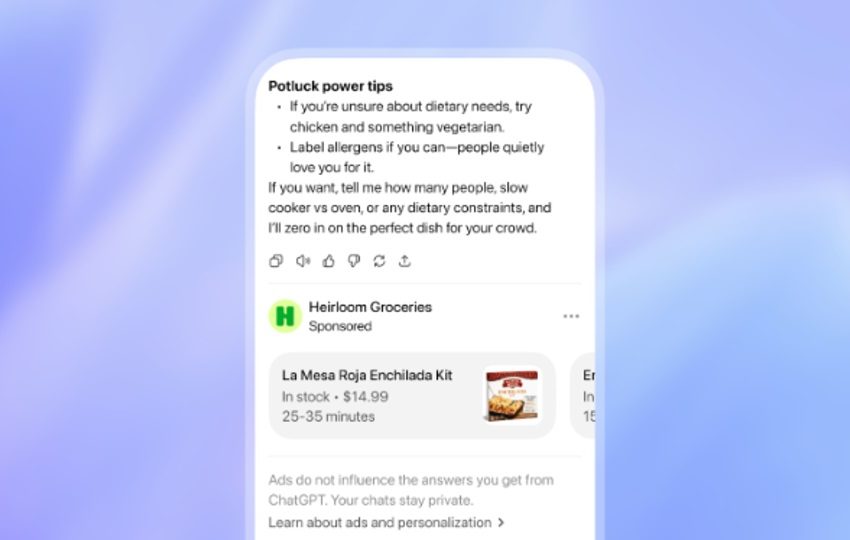
Yes, ChatGPT has started showing sponsored results inside user conversations: this is a significant moment.
But before we get into what it means for your business, let’s take a quick detour into Internet history. If you’ve been online long enough, this may seem like Ground Hog Day.
The Oldest Story in Tech
In 2024 Sam Altman, head of Open AI, said “I kind of think of ads as like a last resort for us for a business model,”
Writer and internet critic Cory Doctorow has a word for what happens to every platform that starts life as a free, brilliant, too-good-to-be-true service: “enshittification”.
Doctorow describes the pattern like this:
“First, they are good to their users. Then they abuse their users to make things better for their business customers. Finally, they abuse those business customers to claw back all the value for themselves.“
Think about Facebook. Remember when it just… showed you posts from people you followed? Then it started inserting brand content to help businesses reach you. Then it made those businesses pay for the privilege of reaching you. Then it squeezed them on price. Then it added more ads. Then more. Then it made the algorithm so opaque that nobody — user or business — really understood what they were seeing or why.
The platform went from useful tool to attention slot machine, optimised not for you but for the shareholders.
Google did the same thing. Search results used to be search results. Now a decent chunk of any results page is ads, AI summaries, and things Google wants you to click rather than what you were actually looking for.
And now, right on schedule, it’s ChatGPT’s turn.
OpenAI launched a beta self-serve Ads Manager in May 2026 — meaning businesses can now sign up, set a budget, and buy sponsored placements inside ChatGPT conversations.
Is This the Beginning of the End?
Probably not immediately. But it is the beginning of the beginning of the end, if history is any guide.
Right now, OpenAI genuinely seems to be trying to do this carefully. Advertisers don’t get access to individual conversations. Campaign data is reported in aggregate. The ads appear in what OpenAI describes as relevant contexts rather than blasted everywhere regardless of intent.
That’s reassuring, but it also sounds a lot like every platform in the early days of monetisation, when the product team still had more power than the revenue team.
What’s Actually Happening With ChatGPT Ads?
Until recently, advertising inside ChatGPT wasn’t something most businesses could access. In May 2026 OpenAI launched a proper self-serve Ads Manager — sign up, add a payment method, set a budget, upload your ad, launch a campaign. The infrastructure now includes cost-per-click bidding and measurement tools so you can actually understand what’s working.
In simple terms: ChatGPT advertising has moved from a closed experiment to an open (if still developing) ecosystem. It’s not yet Google Ads in terms of maturity, but the direction is clear.
Why This Is Different From Normal Advertising
Most digital advertising interrupts you.
You’re reading an article, and a banner appears. You’re watching a video, and an ad plays first. You’re scrolling social media, and a promoted post slides in. In all of these cases, the ad is targeting you based on who you are or what you’ve previously done — not what you’re thinking about right now.
ChatGPT is different because people use it when they’re actively trying to work something out. They’re comparing options. Researching services. Trying to understand a financial product, a health question, a software decision. They’ve already formed a question; they want an answer.
That’s an entirely different mindset from someone passively scrolling Instagram. The intent is already there. The decision-making is already in progress.
For businesses, that’s potentially very valuable. An ad that appears when someone is mid-research on exactly the problem you solve is far more relevant than an ad that appears because an algorithm thinks you might be vaguely interested.
The flip side — and this is where Doctorow’s pessimism feels relevant — is that this is also precisely why the commercial pressure to insert more ads, in less relevant contexts, for more money, will be enormous. The more valuable the placement, the harder the platform will squeeze to extract that value.
What This Means for SEO and Organic Visibility
It would be a mistake to treat ChatGPT ads as purely a paid media question.
People are increasingly using AI tools the way they used to use search engines — but more so. They’re asking for recommendations, summaries, comparisons and explanations. They’re making decisions based on what the AI tells them.
That means your business needs to exist credibly in the broader information ecosystem that AI tools draw from. Not just on your own website. Not just on Google. Across the web —
- in reviews,
- in press coverage,
- in third-party sources,
- in the kinds of content that gives an AI enough signal to trust and recommend you.
The question is no longer just “do we rank on page one of Google?” It’s “if someone asks ChatGPT who they should use for X, are we in the conversation?”
Paid advertising might help you appear inside the platform. But organic authority determines whether you deserve to be there — and whether you’re visible everywhere else too.
What About Measuring Results?
OpenAI has introduced measurement tools that track whether users take action after seeing an ad — visits, enquiries, purchases, depending on how your campaign is set up. That moves it away from vague “awareness” metrics and toward performance measurement that finance directors actually care about.
What About Privacy?
The privacy piece is also worth noting. Advertisers don’t receive individual conversation data — reporting is aggregated. That’s important, because ChatGPT is a deeply personal tool. People ask it things they wouldn’t type into Google. For ads to work in that context without killing user trust, the platform has to walk a very careful line.
Whether it continues to walk that line as commercial pressure mounts is, again, a question worth keeping one eye on.
What Businesses Should Do Now
Most businesses don’t need to rush into ChatGPT advertising today. The platform is still developing and access is still rolling out.
But you should be preparing for a world where AI platforms play a bigger role in how people discover, compare and choose.
The first step isn’t necessarily launching a campaign. It’s understanding how your business currently appears in the broader online ecosystem.
Ask yourself: Is your brand clearly associated with the services you want to be known for? Do trusted third-party sources mention and validate your expertise? Does your website answer the questions your actual customers are asking? Would an AI platform have enough credible information about you to confidently recommend you?
These aren’t just AI readiness questions. They’re the fundamentals of modern visibility — and if the answer to any of them is “probably not,” that’s where to start.
The Bigger Picture
ChatGPT running ads is not just a new ad format. It’s a signal that AI platforms are becoming part of the customer journey in the same way search engines did — and that the commercial model that funds them will shape the experience, for better or worse.
Traditional search gave people links. AI gives people answers. That shift changes what you need to optimise for, and it changes what “being visible” actually means.
- SEO helps ensure your website can be found, understood and trusted.
- Digital PR builds the external signals that reinforce your authority.
- Content answers the real questions your audience is asking.
- Reputation tells the platform — and the person — that you can be trusted.
- Paid media may create additional presence at the moment of intent.
The strongest strategies won’t treat these as separate channels. They’ll bring them together.
This applies to other AI tools, like Perplexity, Gemini, etc
And they’ll build foundations that survive whatever the next round of platform enshittification brings.
Because it will bring something. It always does.
At Datadial, we’re helping business build the credibility, visibility and authority needed to be found, trusted and chosen in an increasingly AI-driven world. Whether that’s through organic search, digital PR, content or paid media, the goal is the same: building something real that lasts beyond the next algorithm change.
Or the next ad format. Whichever comes first.